The Death of a Very Close Friend

I originally wrote this eulogy for those who knew my friend. I post it here since it is not only about my friend’s life, but about a way of life, and about the Tree of Life. It is also about death, about karma and the communion of saints, about Buddhism and Christianity, about smiling and singing. All my writing is personal since I know no other way of thinking. Yet this is more personal than most. So I ask anyone who chooses to read on to permit my weave of reminiscence with broader reflection, as well as the resultant length.

My very good friend Joe Kroger died on July 18 from complications following heart surgery. He was 76 and only a month retired from 45 years as Professor of Religious Studies at St. Michael’s College in Burlington VT.

I first met Joe in August 1959 when we joined a group of “novices” at a monastic solitude in upstate New York, just a year-long induction to a way of life we’d all been attracted to. It was the way of a group or “order” of Catholic Brothers (mostly monks, some priests) called the “Society of Mary” or “Marianists.”

Most of us were just out of high-schools run by those Brothers, graduates of what today might be called “elite” prep schools for boys, but back then were simply the next step of aspiration in the Catholic world of places like Joe’s Cincinnati and my New York.

Filled with the energy of youth and the optimism of that period, yet also a bit frightened and challenged, we made friends quickly and often very deeply – friendships which in many cases have lasted now almost 60 years. So let me first say something about the “common bond” among those men, for it was the context of my long friendship with Joe.

The years have, of course, taken their toll. Joe’s death is a memento mori, a reminder that we don’t need to ask for whom the bell tolls. Yet far more important than their toll has been the joy and achievement and love experienced through those years, even amidst (often because of) the serious challenges each of us has faced.

I admit bias here, but do not hesitate to say that much real good (or “good karma”) has been brought into this world by that remarkable group of young men I became friends with back then. So I now think of our interwoven lives as one branch – knotted and twisted but still blossoming – of the Tree of Life. And I’m grateful that there are so many similar branches around the world.

We were Marianists together as we grew into a brotherhood larger and more interesting than we’d first imagined. Then, for various personal and cultural reasons, we were former-Marianists still sharing a bond of brotherhood. We have worked (some still do) in an amazing variety of careers: many were teachers and professors, in science and humanities, engineering and arts; many did corporate personnel work or civic social service; others had successful business careers; some have been very good artists, writers, and actors; others lawyers and doctors and environmental biologists. Some of the priests who left the community continued to serve elsewhere as Catholic priests; some who left the brotherhood became priests or ministers in various Christian denominations. Most have remained Catholics, often active in parish or diocesan ministries and even in national church offices; others (like Joe) took up different forms of belief (his was Buddhist); and many are happily secular in their humanism. As men they experienced the great but ordinary joys and hurts of relationship with lovers and wives (and now some with husbands), with their sons and daughters, with friends and enemies.

That is the context for my memories of Joe, and the memories give particularity to that larger context.

Yet living again with those memories in recent days, and at his funeral this past weekend, I find myself overwhelmed. Because the memories are so many, and so good. But also because I embrace Joe’s belief in karma as the ever-renewing energy of compassion. So for me, quite honestly, these are not just memories, they were and remain realities – real “moments,” if you will, or “pulses” wherein Joe’s richly good karma continues to contribute to that fundamental cosmic flow of compassion. Some might want to think of such reality (as I also do) as the “communion of saints” or the “resurrection and the life.” In times of immediate loss (and of so much death globally) it can be difficult to sustain such belief. Yet they are the gift of two of the world’s great religions.

A brief outline of Joe’s life might be helpful here. After a number of years with the Marianists, teaching in Dayton OH and doing graduate studies at Georgetown and St. Louis U., Joe decided to leave that life. He married, did graduate studies at McMaster University (Ontario) where his son was born, then moved to Vermont. Over the years at St. Mike’s he taught courses on Buddhism and Hinduism and Christianity and became a leader in the faculty.  He frequently took students on study trips to Mexico and El Salvador (as part of his interest in liberation theology) and once to Japan (following his interest in Buddhism). He was very active in work for social justice and was advisor and campaign manager for his wife Althea’s political career in the Vermont House (four terms) and Senate (two terms). More recently he and Althea split the year between his work at St. Mikes and her educational business in Poland. After her death 5 years ago, he began a gradual retirement which allowed him to spend the Fall semester in Burlington and to enjoy their condo in Florida during Vermont’s very cold winters. He chose to do recommended heart-valve replacement surgery this July as part of his transition to full-time retirement. Yet unexpected complications followed the surgery and he died surrounded by family (his son’s and the larger Kroger family).

Joe and I had good arguments from the first – what guys often do as a way of talking.

During one long car trip from Krakow to Budapest we finally seemed to sort out the difference between his Buddhist belief in karma and my Christian conviction about the resurrection, a difference which had grown over years of study and experience. More recently, one evening in San Diego, Joe joined another brother in virtually silencing my counter arguments defending Catholicism – no easy achievement. Even more recently, at his winter home in St. Augustine, my wife joined us in a far ranging dialogue between Presbyterian, Buddhist, and Catholic. At night, on the balcony overlooking the ocean, Joe and I enjoyed cigars and the three of us sipped cognac as the dialogue gently released into the rolling music of the surf and the silent song of star-lit sky.

Joe’s “buddhist catholicism” (my term) was complex. Roman Catholicism was the rich soil of his family’s life and led to his years with the Marianists. He did graduate studies in philosophy at Georgetown and began seminary studies at St. Louis University. After he left the Marianists, Joe married Althea Przybylo, a Polish Catholic woman from Chicago. For his PhD at McMaster he specialized in philosophy of religion with a minor field in Hinduism and Buddhism (my course of studies as well when I joined him there a few years later). He then became professor of religious studies at St. Michael’s.

His move away from a supernaturalist or “two-story universe” worldview reflected currents in theological and religious studies in the 1960s and since – remember the “death of god theology” and the important Marxist influence on “liberation theology” which Joe studied and embraced. But I sensed in our discussions that his shift away from Christianity was most affected by a particularly skeptical form of “historical Jesus research” – an effort to identify the actual words and actions of Jesus of Nazareth in order to distinguish them from later Christian beliefs about Jesus Christ. Said differently, I think he found in Buddhist “naturalism” (no two-story universe) a religious but deeply humanist alternative to the way he understood Christianity.

He regularly taught courses on Buddhism and Hinduism which he had studied not only at McMaster, but later at the University of Hawaii and in his meticulous preparation for classes. He also regularly courses on Christianity. He rejected Christian “metaphysics” as he understood it, but remained deeply Christian in his practice and sensibility. He was very active in the Catholic group Pax Christi  in Burlington and in other Christian work for peace and justice. He will be buried, quite appropriately, next to his wife at a Catholic cemetary in Chicago.

Those who knew him remember his strong and beautiful tenor voice. First noticed by the likes of me in that upstate New York solitude when, each evening, we would encircle an outdoor stature of Mary and one of us (often he) would intone the immensely beautiful plainchant “Salve Regina” before the rest of us joined in full-throated chorus. At McMaster he sang in the Bach Chorale and has since always been involved with some form of choral singing, most recently with a St. Augustine group that did both musical comedy and classical cantatas. On a more personal note, he and Althea sang Paul Stookey’s “Wedding Song” at my wedding in 1971; more recently he sang Bob Dylan’s “Forever Young” at our son Peter’s funeral in 2004. I believe that he sings still today, accompanying the great Cosmic Dance.

Friends would joke about his penchant for order. I’ve already mentioned meticulous class preparation — not pedantic but deeply serious. To enter his office and even more his home was to experience the quiet beauty of such order — in his large library of carefully selected books or the video collection of much-loved films, or just in his kitchen. And he, unlike many of us, knew where each book was and should be. He kept an collection of stand-out student papers which he’d consult when asked for letters of reference or emailed with greetings. And all this literary order was, in his home especially, framed within the quiet beauty of visual art – family photos, to be sure, but even more prominently a number of large and strikingly contemplative Hindu and Buddhist sculptures, especially one bronze Buddha which Althea somehow had managed to ship from Asia despite its size and weight.

His quest for clarity and order came to another beautiful consummation with the publication of Aztec Goddesses and Christian Madonnas: Images of the Divine Feminine in Mexico (Ashgate, 2012), co-authored with his Mexican anthropologist friend Patrizia Granziera. The book gives rich detail about “the divine feminine” in Mexican history and culture, along with pages of images (most of the Madonna photos taken by Joe during travel in rural Mexico). The book is encyclopedic, but with analytic seriousness – not just a collection of facts and images, but a historical and comparative contribution to contemporary feminist studies. It’s not hard to see how his study grew from Catholic and Marianist roots and the later influence of liberation theology. (See my short review and reflection on the book for The Denver Post.)

Joe was above all an adventurer, in his own uniquely steady and persistent way. His first major adventure was joining the Marianists. That, in retrospect, was the beginning of the larger philosophical and religious adventure of his adult life, with its years of study and teaching and travel. Yet there were also smaller adventures. In Vermont he became a licensed pilot, eventually rated for small-engine commercial flight. He did it for fun and because flying also involved the skilled mastery of so much technical detail. He also had “flying fun” on his motorcycle, and undoubtedly read Robert Pirsig’s best seller Zen and the Art of Motorcycle Maintenance.

Yet the great adventure is the one he took with his remarkable wife Althea. It took them together from St. Louis to Canada where their son Andrew (now a medical doctor with the CDC in Atlanta) was born. It led them to his academic work at St. Michael’s and her important contributions to Vermont politics. Along the way she did graduate degrees in politics and law and government at the University of Vermont and Harvard’s Kennedy School of Government. Yet her political career was cruelly interrupted by a brutal cancer which she somehow beat. That scrape with death led her (with him) to a long-dreamed connection with her Polish homeland – where they opened an English language school for business and civic leaders in her family’s hometown east of Krakow. They then commuted between Vermont and Poland, maintaining two careers and occasionally finding vacation time in Florida. Then came a second and mercifully short bout with another cancer that led to her death in 2012.

Let me end with one final form reminiscence. We humans are embodied spirits and nowhere is the spirit more evident than in our faces. Joe had a wonderfully bright and gentle smile that graced his handsome, strong-jawed and clear-eyed face. Yet he had many other characteristic facial gestures: the intentness of his listening and pausing; the slight swing of his head, with quizzical eyes, as he responded to my typically sweeping assertions; the serious look which accompanied his counter assertions; an often relaxed calm of content (most recently for me with cigar and cognac in hand); the energetic intensity of eyes and jaw when he sang; the big happy laugh which I remember especially when he bounced a Polish grand-nephew on his knee. These gestures, as I’ve said and believe, now grace all creation.

In the big picture of world “news,” his life and passing is hardly noticed and will be quickly lost. Even on the great Tree of Life, his bud and blossoming seems small indeed. Yet the small is in fact the most real – the gestures and moments of our lives what really count. The tree grows, as does the dance, only one bud or movement at a time. We know this in the day by day reality of our lives, but need to be reminded lest we get, as T. S. Eliot said, “distracted by distraction.” Perhaps more positively expressed is the Buddhist call to re-minding: “chop wood, carry water.” Amen, and alleluia.
Truth and Mercy: The Church of Good Pope Francis

There I was, sitting with the dog outside Denver’s renovated Union Station in what we call LoDo (lower downtown). It was about 5 on a typical summer Friday evening. Folks passing bye, some strolling, others in a rush. Families and friends heading up the block for the Rockies game (yes, just next door). Some oldsters like myself, strolling or sitting. Many youngsters: some leaving work; couples starting the night; singles beginning the evening dance – groups of guys, gaggles of gals dressed to kill, mixed groups laughing with anticipation. Occasionally some costumed leftovers from the Comecon convention earlier that week passed by, as also others in new culture tats  and leather and metal, silver studs and shocking hair.  And yes, there were today’s omnipresent security folks; this time two cops on bikes stopping to chat with a family about the Rockies caught my applause.

And always there are particular individuals I end up chating with, that evening an old man and a young woman at separate stands selling ball-game treats. He’s been there for years – a very heavy, wheelchaired whitehaired African-American guy called “Bear.” He always has treats for the dog and his stand is the happiest place on the walkway! Up the block, she was reading a physics textbook at her stand. I was curious and asked. She’s getting ready to start a program at UC Denver which prepares people to become austronauts or to work in Denver’s large aero-space industry. And yes, she too was African American, though quite petite.

There were folks radiating sexual or romantic energy.  And others radiating muscled anger. Some were rushed; others just beginning to relax. Headed home or to one of Lo Do’s night venues.

It struck me as a somewhat typical melange of contemporary diversity. Yes there would have been more minorities in other neighborhoods and cities, but African Americans, Hispanics, and Asians, along with Muslims of various nationalities, were well represented in the predominantly white parade.

Which reminds me now of an evening dog-walk last Fall when a guy got out of his cab, spread a rug in the direction of Mecca, and quietly began his prayers. And this turns thought not just to racial and ethnic diversity, but to the beliefs and practices, the ethics and inclinations in this melange of contemporary Americans.

For a while I played my “Trump game” – trying to figure out, just by appearances, who might have voted for our misfit president.

Then (such is the strangeness of my Catholic sensibility) I thought about Denver’s former Archbishop Charles Chaput – now happily transferred to Philadelphia. He more than once has called for a leaner, more orthodox Church of “true Catholics” rather than the present church which includes so many he once dismissed as “protestants who happen to go to communion.” He has of late also joined with others raising doubts about the supposed novelties and deviations of Francis’ papacy.  Yet Francis recently has, at least in effect, returned the favor by passing over Charles in the latest appointment of Catholic Cardinals for the US (something traditionally awarded to Philidalphia),  He gave the red hat instead to Joe Tobin in (of all places) Newark, a man closer in vision and sensibility to Francis than to Charles or to New York City’s cardinal, Timothy Dolan.

I’m far from alone in making this contrast between “the church of Francis” and “the church of Charles.” Yet we all need to be careful with contrasts lest they get reduced to simplistic polarizations, to good guys and bad guys thinking. Indeed, important and complicated differences are involved in the contrast between these two ways of understanding Roman Catholicism.

Concern for truth and orthodoxy, for staying the course, along with calls for resistance to the world’s pervasive and simplistic relativism, are these days very important, necessary, and wise. Even our appropriately secular and skeptical media are making similar calls in response to bashing from the twitterer-in-chief and his cronies — continual accusations about false news, continual lying and the deliberate spread of “alternative facts,” all contributing to an environment where truth is dismissed, propaganda expected, and only power important. Indeed, serious Catholic thinkers (Alasdair MacIntyre comes to mind) have of long been calling for monastic retreat from the barbarism of contemporary society.

Yet such a “Benedict option,” as it’s recently been called (and as I’m suggesting is a central aspect of “Charles’ church”), however understandable and perhaps necessary for some times and places, is at best a partial solution to the challenge of our times, and at worst a betrayal of the Gospel. For it can too easily become a form of idolatry whereby the Church replaces its Lord and effectively limits His command to bring the good news to all nations and peoples.

An expansive understanding of that evangelical imperative has, since the first, been the hallmark of “the church of Francis,” indeed a hallmark of the church envisioned by Vatican Council II. Francis would undoubtedly reject my notion of “his” church, but he has clearly embraced the Council’s expansive mission to embrace the “Joys and Hopes” of contemporary humanity.  Indeed, his first major writing on “The Joy of the Gospel” elaborates beautifully what he has elsewhere said again and again about the need to go into the streets to witness to God’s mercy, to both serve and learn from the folks. It’s worth a careful reading, even regular re-reading.

And that, of course, brings me back to the streets of LoDo.

My guess is that a significant number of the folks that night had voted for Trump.  And that the vast majority would not qualify for “Charles’ church.” Nor would most want in. Certainly not the faithful Muslims and Jews and non-Catholic Christians among them. Nor the still-growing number of ex-Catholics (though some have also “returned home”).  I’m guessing that most of the GLBT folks in that crowd would also not want in, nor – far more significantly – would many of the young folks out for an evening of drink and song, romance and perhaps sex.

Yet many such folks might, at least in my musing, be interested in Francis, perhaps even in his church. He’s gotten much good press.  And he is clearly very interested in them. In the poorer folks in that crowd (fewer that evening than earlier in the day), and in the many families (whatever their faith), and perhaps especially in the young folk. He knows that many of them wouldn’t share Catholic truth about sexual ethics and simplicity of life, or even about the goodness of God’s world and the omnipresence of Mercy. More often (again, in my experience) they’re impressed by the dangers and evils of this world – by pervasive infidelities of all sorts, by too many crooks running too many things, by so many forms of predatory violence, and by the general unreliability of most proclaimed truths.

Yet Francis has challenged the Church to be truly catholic and universal – NOT to retreat into enclaves of so-called goodness, but to mix with the many who don’t necessarily share our sense of goodness, who may well suspect and at times fear and even hate us. He’s called us to “evangelize” (a good word even if we have warranted misgivings about it): to live and share the joy of the Gospel’s central truth about the Great Mercy and to give expression to that joy by many forms of welcome, compassion, real dialogue and friendship, or at least just by plain old respect.

I very much enjoyed the vitality and general friendliness of that Friday night, even as I was touched by tension and anxiety emanating from some and by tough anger emanating from others. I felt at home there partly because I now live now right next door. But mostly because I have thankfully long been loosed from the fearful confines of “Charles’ church,” however important it remains. I say “thankfully” since that loosening still feels like having demons cast out, even if it also at times still feels like having left home. I have long hungered for Francis’ less angry and less fearful church. Yes, he lives the traditional truths of Catholicism, but understands them as grounded and guided by the fundamental Truth of God’s goodness and mercy.  He’s not (as I’ve written previously) changing Catholic truth, but re-visioning it within a new, more expansive and evangelical paradigm.

So, yes, Archbishop Charles notwithstanding, I do think all those folks (myself hopefully included) are part of the “body of Christ.” The Roman Catholic Church and Tradition are (or should be) a sign, an example, a living embodiment of Christ’s presence (in grace, inspiration, hope, suffering) for this world which God so loves. And yes, the Christian Church more broadly is crucial for our discernment of and partaking in that love, even as the bustling energies of that LoDo crowd also embody, each in its way, that love.

But if the world often loses its way, so does the Church. Roman Catholicism is clearly sailing on troubled waters. Charles and his comrads honestly believe, as partakers of the very long and deeply conservative dimension of Catholicism, that these are times when the Church must hunker down and resist the world’s many evils in order to be able, “from under the rubble” (as Solzhenitzyn wrote), to bear witness to the Light. I agree and disagree, but basically find more of that Light with Francis and his new crowd. Yet I’m also aware of the great historic irony that an earlier moment of withdrawing from the world into monastic enclaves – during what some historians still call “the dark ages” – initiated the expansive evangelical flowering which converted our barbarian ancestors and came to fruition in European Christendom.

The Church needs both these “churches” (and others). Each by concerned criticism might help the other to be loosed from its demons and idols. More significantly, together (and in tension) they might serve those many in this not-so-brave-new-world who still have time for Friday fun even if their Sunday is taken up with supplies and  lawns and laundry.

Going Good — The Yankees, Jimmy Carter, and Our Body of Faith

My previous blog (scroll down for “Breaking Bad”) described the cancerous oligarchy whose disease has metastasized into our civic “body of faith.” Today I write about healing that body.  I hope it doesn’t get either too academic or too homiletic.

But first a crucial point: threats to the health of our body of faith don’t just come from the kinds of politics I last wrote about. They come from many sources of our wariness and fear, from daily diminishments in courtesy and respect as well big hassles with impersonal systems.

How, then, do we nourish what remains of our body of basic trust, and grow its healing strength into the malignant parts of ourselves and our society? For that, nothing less, is the challenge we face.

First, two simple examples.

I recently talked with another scholar about the Yankees. It was actually quite serious. I’d made reference to my childhood kinship with Yankee fans, but he missed the point and dismissed professional sports as “just entertainment.” So I asked him, a Chicago resident, whether the Cubs were “just entertainment” in Chicago. When he hesitated, I told him my experience of “Bronco Sundays” in Denver. Here, if just for a moment, our many real civic, ethnic, racial, and economic divisions are typically set aside when the Broncos play. In the stands, at pubs, on the streets, the African-American bus driver shares groans and high fives with an Anglo businessman and an Hispanic construction worker. When so many wear Broncos shirts, orange is the only color that matters. It’s not “just entertainment,” though it certainly is that, and very good business as well.  And it too often involves the corruptions of big money, superficial celebrity, and impersonal systems. Finally, though (this was the missed point), the sports teams in places like Denver and Chicago and New York, and local teams in all parts of this country (and every country of the world) embody and express a feeling of shared pride and hope for city or town or even for the whole country (think Olympic women’s soccer). It’s a small thing, and temporary, yet still contributes significantly (as do so many “small” things!)  to our body of faith.  And thankfully the Colorado Rockies are winning big so far this year, as are the Yankees.  (Dreams of an improbable World Series.)

There’s also a much simpler story you may have seen on the news. Jimmy Carter recently got on a flight leaving Atlanta and proceeded down the aisle to shake hands and exchange greetings with everyone on the plane. Perhaps Carter can do this sort of thing since he’s known for tireless church work, for supporting groups like Habitat, and for the Carter Center’s peace work around the world. He’s know to be trustworthy and generous, so his walk down that aisle was newsworthy for its simple way of expressing our shared body of trust.

Take a moment and you’ll find many other examples from your own experience.

That such interactions both express and nourish a “body of faith” is an idea I take from my mentor (and fellow Yankee fan) William Lynch, SJ.  He argued that  our human city (in all its many forms) is above all a “body of faith” and not just a complex tangle of structures and interests. He asked us to imagine the city realistically, in its rich complexity. It grew and lives most fundamentally because enough people trusted each other to join their resources and energies – people as different and often in conflict as business owners and workers, Catholics and Jews and Protestants, teachers and bureaucrats and parents, cops and kids, courts and lawyers…. And, yes, women and men. So while building a city (or town or country) clearly takes money and work, streets and structures, systems and skills, the city doesn’t work well (and often not at all) when wariness and distrust grow beyond a tolerable (and necessary) level. Without a sense that “the other,” even when we really differ and disagree, is basically trustworthy, the human city starts to die, replaced by warring camps and walled enclaves.

In classical political thought, we need the “cardinal virtues” or fundamental strengths of prudence, justice, courage, and moderation to build up our human city. Christian belief urges as well that we open minds and hearts to the “theological” virtues of faith, hope, and charity. These virtues, named abstractly here, are the resources we need to fight the cancers of fear and distrust and to build a more human city

Yet we learn and develop such virtues in real life and not from abstract concepts. We inherit them as practices already embodied in the life of our families and schools, in commerce and sport.  They hopefully become personal habits or strengths as we grow, habits in our individual lives and in our society.  And then we together, often with great difficulty, develop new forms for their practice in face of the challenges of our times.

We are, then, very blessed to find many forms and practices of real virtue among us — real habits of the heart, embodied in institutions and folkways: in hospitals and shops, governments and clubs and churches.  And expressed daily in many kinds of ritual and gesture such as Carter’s aisle-walk or the sports-fans’ high fives.  Sure much of this can be phony, but fortunately much of it is quite real.

Such shared virtue is also embodied in movements or currents of thought and action – like growing concern for good food (for all) and the corresponding growth of locavore economies. Like our much conflicted but fundamentally humanizing concern for gender respect and equality. (“For the rising of the women [really] is the rising of the race” as the labor song “Bread and Roses” once put it ). Or like our equally conflicted yet crucial movements for good education and health care in cities and towns across the country. And for better public transportation. And in the currently powerful movement of an ecumenical spirit among churches and between religions.  And perhaps most fundamentally in our again very conflicted but growing awareness of environmental crisis and its connection to  poverty and political unrest.  And in many forms of response  to such awareness — often competing, but more typically collaborative.

I realize, of course, that my listing of such movements reflects my experience and perspective. There undoubtedly are other movements I don’t understand, and even at times oppose, which nonetheless in their ways also contribute to building up our body of faith.  I, for instance, don’t like the continual media drum roll of “puffed-up military patriotism.”   Yet I’ve known so many folks whose years of military service contributed greatly to their goodness and contributes still to building up our shared body of faith. We clearly know as well that there are many movements of culture and consciousness which embody and embolden vice rather than virtue.

Pope Francis, in his first great writing “The Joy of the Gospel” called us to pay serious attention to the cultural and political movements of our time, and to discern what in them manifests aspects of God’s Kingdom and what might express forms of life opposed to God’s reign.  See especially his second chapter “Amidst the Crisis of Communal Commitment.”

Of course, far more fundamentally than by his writings, it has been the person of this pope, his spirit and iconic actions, which have restored for so many around the globe a sense of civic hope and purpose. So I urge readers to dwell in prayerful imagination on the memory of public moments (whether by a pope, a president, or by any who evoke admiration), but even more to dwell in memory and awareness of similar but more “ordinary” moments from our day (something the Jesuits call “Examen”), and most fundamentally to allow such imaginative reflection to arise as we prayerfully enter into scenes from the Gospels (for this is the central form of Ignatian spiritual practice). By such imaginative (and prayerful) indwelling we gain strength to resist being overwhelmed by the bad news and bad faith which daily weaken us — to resist by attention to the broader reach of reality, by making our own in hearts and heads the real people and actual events (big or small) which embody trust and nourish hope.  This is not an escape from all that is breaking bad, but regular recovery of the solid and real ground of prudence and courage, justice and charity.

Reading too can nourish such attention and imagination, so I do not hesitate to suggest that folks of all faiths take up Pope Francis’ writings. I’d especially recommend rereading now and then his Sept. 24, 2015 address to a joint session of Congress and to all of us in this country.  It is a short but unflinching discussion of the great challenges we face, replete with continual calls for dialogue as the way of proceeding, important for emphasizing the iconic witness of Abraham Lincoln and Martin Luther King, Dorothy Day and Thomas Merton, and issuing a warning that “we must especially guard against the simplistic reductionism which sees only good or evil; or, if you will, the righteous and sinners. [For] The contemporary world, with its open wounds which affect so many of our brothers and sisters, demands that we confront every form of polarization which would divide it into these two camps.”

Of course there are many sources for such reading and meditation, classical and contemporary, serious and comic. And I hope some  readers might respond below with their recommendations.  Finally, though, such reading and dialogue (what Catholic Worker co-founder Peter Maurin called the “clarification of thought”) would remain empty without daily practice or action in all our institutional and civic settings.

I suspect most of us struggle to find our own ways of making such contributions to building our body of faith in the many different settings of our lives.

So let me close with examples of contributions which suggest the importance of poetry and song for helping us in such struggle.  Each example also provides a wonderfully different, quite different, woman’s voice to ways of “going good.” [As does the voice of Denise Levertov added by Kevin Burke, SJ’s comment below.]  Readers, of course, surely also know other and better examples.

My first “example” is Rita Connelly’s remarkable rendition in Parliament of “The Deer’s Cry” (traced back to St. Patrick himself) at the November 2011 inauguration of Irish President Michael Higgins.  Take time to look and listen.

Then there are the words of a poem by Mary Karr recently published in Commonweal.  Here is the text:

The Voice of God

Ninety percent of what’s wrong with you
could be cured with a hot bath,
says God from the bowels of the subway.
but we want magic, to win
the lottery we never bought a ticket for.
(Tenderly, the monks chant, embrace
the suffering.) The voice of God does not pander,
offers no five-year plan, no long-term
solution, nary an edict. It is small & fond & local.
Don’t look for your initials in the geese
honking overhead or to see thru the glass even
darkly. It says the most obvious crap—
put down that gun, you need a sandwich.


Breaking Bad

I was going to title this essay “The O’Reilly Factor” after I’d learned that recently fired Fox TV celebrity Bill O’Reilly had graduated from my all boys Catholic high school and has of late been a featured speaker at the school’s “career night.”  But I decided that would be unfair since I’d never seen his show and actually know little about the guy, even though I have a distinct image of him from TV and print news reports.  So I shifted my title to another TV show I’ve never seen, but whose content seems to describe the kind of  corruption I want to write about — the poisoning of public life by a particular class of wealthy and powerful people who, while they have long been breaking bad , again constitute a very dangerous oligarchy.

Yet I have still struggled with this writing because I am making an accusation of evil.  God alone is final judge, and I don’t judge the soul of any person  in this class.  Yet we are all obligated to judge the evil values and attitudes, actions and behavior of individuals and social classes, whether rich or poor.  And we must try to get it right.  So I invite my reader to respond below if s/he thinks I have not gotten it right.

My broad and widely shared concern is to understand “what’s happening” in our country, especially in this writing to understand what’s “breaking bad.”  Of course, many factors contribute to our present.  Most fundamental is the immense force of modern and now post-modern developments.  While they have brought much good, they have nonetheless swept away many of the boundaries and signposts which once guided us.  Thus it is too often the case, in the words of Yeats’ “The Second Coming,” that:

Things fall apart; the centre cannot hold; / Mere anarchy is loosed upon the world, / The blood dimmed tide is loosed, and everywhere / The ceremony of innocence is drowned; / The best lack all conviction, while the worst / Are full of passionate intensity.

Surely some revelation is at hand; / Surely the Second Coming is at hand.

And what rough beast, its hour come round at last, /Slouches towards Bethlehem to be born?

One result of such falling apart and innocence drowned is the growing visibility of a banal but brutal class, a “rough beast” that must be challenged and, if possible, changed. It is a recurrence among us of the kind of tyranny that’s risen again and again throughout history, now given great power by celebrity and wealth. It is a corruption, indeed a cancer in the body politic, a destroyer of the body of trust upon which our society is built.

Yet I am not using “class” the way Marx did. Or, perhaps better, the class I’m speaking about is only one element in our capitalist system, one particularly arrogant and brutal element.  Said differently, this is not just about the potentially corrupting power of wealth in our ruling capitalist class, even though criticism of that class must continue.

Nor am I hear referring to the “filthy rich” featured so prominently in our media, most of whom have been diminished to triviality by wealth and celebrity. They may be hangers-on, but they are not leaders of the class I’m talking about: a class of new robber barons, an oligarchy typified by but certainly not limited to public figures like Trump and O’Reilly (at least as I imagine him to be).

Let me put this another way.  We are comfortable talking about corrupt oligarchies in Russia or China, in the Muslim world or in Latin America.  But we don’t talk openly about such folks among us. Yet such a perverse and very dangerous oligarchic class (a subset of our capitalist rulers) has come again to the fore in our country – slouching through our many Bethlehems.

If this is true, then the important question becomes how we understand this class and its works so that we might try to change or defeat it – even if there seems little short-term hope of doing so. We need help for such understanding: from historians and sociologists as well as from political and psychological analysts.  I urge my reader to reply below with suggested readings from such folks.

Personally, I understand this perverse oligarchy by drawing on moral and religious traditions about sin and vice.  For I suspect that each of us knows from personal experience how the “deadly sins” of pride, envy, anger, and greed as well as sloth, lust, and gluttony affect us.  These are habits which hold our spirits with vice-like tenacity.  We also know that vice must be countered and eventually transformed by virtue or moral strength.  In classical thinking we need the “cardinal virtues” or fundamental strengths of prudence, justice, courage, and moderation for struggle against vice.  Christian belief urges that we further open our minds and hearts to the grace given strengths of faith, hope, and charity.

Yet if we all can know vice in our own experience, we also probably know how seductive success and prestige and even a modicum of discretionary wealth can be, how they blind us to our vices even while deepening their grip on our spirits.   My hypothesis is that the oligarchy or class I’m describing is comprised of folks whose tendencies to pride and greed, lust and anger (tendencies, again, which we all share) have been deepened by great success and wealth and celebrity, and too little checked by prudence and moderation, or transformed by faith and charity.  Said differently, their vices are forms of moral addiction compounded by wealth and celebrity – something that happens to many of us but seems especially evident in the class I’m writing about.

My most particular concern is with folks like O’Reilly (again, as I imagine him) because of the great benefit they received from good Catholic schooling – something O’Reilly regularly praises at my alma mater’s career nights.  Such schooling (from the intellectual and moral disciplines of primary and high schools through career skills developed in Catholic universities) has enabled many Catholics to “make it” in our country.  And many, including some very wealthy folks, have made significant contributions to our common good through their success in business and the professions and politics.

Yet others have allowed their talents to break bad as part of the rapacious oligarchy I’m targeting – wherein greed reigns, success and celebrity are worshiped, and a pervasive sexism abuses women and disdains the values of family life.

Worse still, this oligarchy regularly orchestrates the kind of political/ideological cheerleading which I identify with folks like O’Reilly.  And the drumbeat of that propaganda has seduced too many religious leaders and misled too many good, hardworking and typically religious folks.

As a result, the corrupting influence of this class has not only (as in Trump’s recent budget proposals) hurt the weak, imprisoned the poor, militarized minds and destroyed social securities, but threatens the basic shared faith and trust which is so fundamental our society.

I will soon try to write in greater detail about that “body of faith” and its strengths and weaknesses.  For now I again invite response below to description of a class that is “breaking bad” for our country and the world.

Welcoming Refugees and Immigrants? Perhaps Even Disrupting for Them?

The other day I wrote to a Tanzanian friend, a priest working to improve Christian-Muslim relations. I told him I’ve been especially concerned of late with the needs of immigrants and refugees in this country. “I am happy to say,” I wrote, “that many churches are responding to those fearing deportation and others being refused refuge.” That churches are speaking out against the current wave of nativist American “populism” and are trying to help our citizens become more welcoming of the stranger. I concluded “It will be a long battle here. So pray for us as we pray for you and your fellow Tanzanians.”

And that is the gist of this writing: to share my concern about the needs of refugees and immigrants and urge that our response to them is perhaps the most important issue facing us in this country.

Of course we all have lists of “most important issues,” for there are many – health care and taxes and jobs and racism and the continuing decline in public trust, and of course worries about violence and war. Yet my intuition tells me that our response in coming years to the pressing reality of global flight and migration will be the greatest test of our humanity and morality.

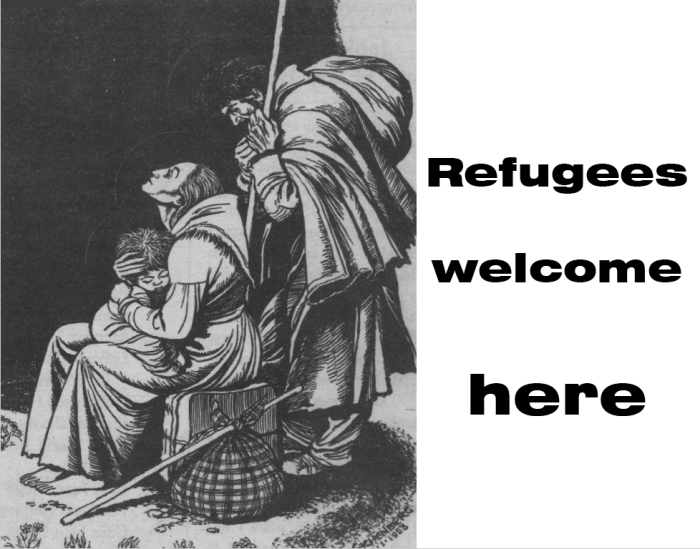
That’s why, shortly after Trump’s first order banning immigration from specific Muslim countries, I stood for a week with a sign during the morning rush hour at a street corner by Union Station in downtown Denver.  I had been inspired by a small demonstration the previous weekend in Denver’s Civic Center Park.

My sign read “Refugees Welcome Here” on one side, and “Jesus Was a Refugee” on the other. Both sides had a blown up reproduction of the famous woodcut by Fritz Eichenberg depicting Jesus, Mary, and Joseph fleeing Herod’s slaughter of the innocents.

Screen Shot 2017-05-08 at 3.57.24 PM

Many in the morning crowd smiled at my sign, some gave thumbs up and high fives. A few identified themselves as refugees. Others looked away or just passed by, while a some gave thumbs down.

There was a big demonstration in Denver at the end of my week where the best sign I saw read “No hate, no fear; refugees are welcome here.” I liked both the rhyme and the explicit naming of hate and fear.  Then in late February there was ceremony welcoming refugees at Union Station hosted by Colorado’s Governor and Denver’s Mayor. The event was clearly designed both as an expression of heartfelt welcome and, with its strong positive tone, as a powerful statement of opposition to anti-immigrant policy and sentiment.  So I then decided to stand with my sign for an hour or so whenever I could during Lent.

These and many other actions and events find much support in the words of church leaders like Pope Francis and San Diego’s Bishop Robert McElroy.  That  good man recently even urged us to “disrupt those who portray refugees as enemies rather than our brothers and sisters in terrible need.

I’m no expert on refugee and immigration issues. I feel greater clarity about the need to welcome those fleeing war, violence, and religious persecution than about immigrants seeking to improve their lives. Yet I do believe that many “illegals immigrants” are in fact fleeing violence, both the gun violence of their home countries and the economic violence (of poverty and oppression) in which our corporations and our government are complicit. Virtually everyone knows that our US immigration policies and practices are a mess, inadequate both to the labor realities of this country and to the dignity of new immigrants. Yet we are terribly divided about what policies and practices are needed.


So I turn for guidance above all to informed church leadership. Here I’ll simply comment on the two already-mentioned Catholic leaders. Yet I urge the  reader to do her own online searching since so many churches (both denominations and individual churches) have made important statements, issued serious studies, and developed practical initiatives (from immediate social services like legal aid and job training to support for various forms of sanctuary).  I am especially impressed by continuing actions on the part of my wife’s Presbyterian Church (PCUSA).

Pope Francis recently got into trouble for criticizing the way refugees flooding into Europe are being held in concentration camps. One predictable sector of Jewish leadership objected since they seem to think the horrific Jewish experience of the Holocaust gives them ownership of the term “concentration camp.” Yet during World War II my aunt, a Maryknoll Sister in the Philippines, spent years in a Japanese concentration camp for American citizens. She was luckier than the US soldiers (imprisoned in what were literally death camps) since locals were allowed to bring food to the civilian camp. Francis, to his credit, did not back down. Conditions in too many “retention centers” throughout Europe justify the name “concentration camp.”    Perhaps it  should also be used about the supposedly more benign detention camps  in the US.

Pope Francis has, or course, long been challenging us to welcome refugees and all “forced migrants.” Perhaps most memorable was his 2016 trip to Greece where he and Orthodox leaders visited refugee camps and whence he brought a family from Syria back to Rome.  Here are words from the joint declaration issued by Francis and Ecumenical Patriarch Bartholomew and Archbishop Ieronymos of Athens:

“The tragedy of forced migration and displacement affects millions, and is fundamentally a crisis of humanity, calling for a response of solidarity, compassion, generosity and an immediate practical commitment of resources. From Lesbos, we appeal to the international community to respond with courage in facing this massive humanitarian crisis and its underlying causes, through diplomatic, political and charitable initiatives, and through cooperative efforts, both in the Middle East and in Europe.”

Francis has also created a new Vatican department on migrants and refugees which reports directly to him. It’s part of his effort to organize churches throughout the world to respond both to the present crisis and the larger reality of global migration.

For me, an even more stirring Christian call to action came from San Diego’s Bishop Robert McElroy in a recent speech to a conference of activists and community organizers. His deeply thoughtful and passionate words were widely reported.  Please read the text  since my brief citations below can’t convey its careful analysis.  It stands in remarkable contrast not only to today’s tweets and TV reports, but even to important but far less provocative statements from other church leaders.

What got attention in press reports was the fact that a Catholic Bishop was calling us to “disrupt” things. What got less attention was McElroy’s explanation that he was taking that term from the Trump campaign’s promises to disrupt the present way of doing things. McElroy was responding in kind, but in a very different direction. He called for “disruption” of the larger political-economic system that (as Pope Francis has repeatedly said) “kills people.”

McElroy never mentions Trump, but doesn’t pull punches in speaking about the present:

Well now, we must all become disruptors. We must disrupt those who would seek to send troops into our streets to deport the undocumented, to rip mothers and fathers from their families. We must disrupt those who portray refugees as enemies rather than our brothers and sisters in terrible need. We must disrupt those who train us to see Muslim men, women and children as forces of fear rather than as children of God. We must disrupt those who seek to rob our medical care, especially from the poor. We must disrupt those who would take even food stamps and nutrition assistance from the mouths of children.”

Yet his call for disruption was prelude to a larger call to rebuild our systems – to make America great again, if you will, but in a very different way than the banal and brutal tendencies of present politics.

But we, as people of faith, as disciples of Jesus Christ, as children of Abraham, as followers of the Prophet Muhammad, as people of all faiths and no faith, we cannot merely be disruptors, we also have to be rebuilders.

We have to rebuild this nation so that we place at its heart the service to the dignity of the human person and assert what the American flag behinds us asserts is our heritage: Every man, woman and child is equal in this nation and called to be equal. We must rebuild a nation in solidarity, what Catholic teaching calls the sense that all of us are the children of the one God, there are no children of a lesser god in our midst. That all of us are called to be cohesive and embrace one another and see ourselves as graced by God. We are called to rebuild our nation which does pay $15 an hour in wages, and provides decent housing, clothing and food for those who are poorest. And we need to rebuild our Earth, which is so much in danger by our own industries.”

Of course it remains to be seen how folks in the pews (Catholic or Presbyterian, Christian or Jewish or Muslim) will respond to such statements by their leaders. For we know that many of them voted for Trump and we may suspect that many are held captive by fear-filled images of the foreigner as a dangerous threat to our way of life.

Yet I stood with my sign knowing that I was in solidarity with many religious and non-religious folk who are today seeking more hopeful directions for our country. I stood with my sign because there are so many people fleeing violence and seeking refuge among us. As did so many Vietnamese after 1975, folks who today are a proud and integral part of Denver and other cities in the US. And because my own Catholic ancestors were refugees, from famine and British brutality in Ireland and from militarism in Germany. And perhaps because I spent the first part of my life in New York City where Lady Liberty has welcomed so many refugees and where generations of immigrants have continually contributed to that city’s great vitality.

I suggest that all of us must find our ways to oppose and disrupt prevailing forms of nativism, but we must seek ways to oppose and disrupt which do not further polarize our country, ways that invite our opponents to join in working towards a more fully human and shared sense of national purpose. I hope it’s possible.

The So-Called “Priest Shortage”

The So-Called “Priest Shortage”

Two things prompt me to write – a dispute between the Denver Archdiocese and a small “mission” church (www.denverpost.com/2017/04/18/our-lady-of-visitation) and the April 17 “Letter from Rome” by Commonweal correspondent Robert Mickens (www.commonwealmagazine.org/letter-rome). By the time you read this the Denver situation may have been resolved (though probably not), but larger issues about priests and people that Mickens addresses will not be solved soon. So I thought I’d add my two cents even though of late I’ve not written much about church reform. Though I won’t be citing history and texts as Mickens so ably does, I will try for accuracy. (And, with apologies to other Christians, I will be using Catholic-speak about “the Church” to refer to Roman Catholicism.)

Let me begin with personal disclosures. I have long known many, many really good Catholic priests, and know about quite a few very, very good bishops, including the present Bishop of Rome. As a young man I spent some good years in training to be a priest, and finally decided against ordination for personal reasons, not because I’d come to any negative judgments about the Catholic priesthood. Yet my reflections today do involve a series of negative judgments – not so much about people as about the theology, traditions, and church law which have led to the so-called “priest shortage”.

To start with that shortage: Yes, there is a shortage of priests in many Catholic countries, but mostly because of bad theology and bad management. As to the latter, it involves, as I see it, narrowness of vision and entrenched self-interest on the part key members of the clerical club. Mickens indicates some of the intense battle which Francis is waging on many fronts with those folks, and you’ve probably read reports of his statements about reconsidering the celibacy rule.

Vocations to the Catholic priesthood are there in abundance – among many married men (including many who have “left the priesthood” in recent decades), and among many, many women (married or single). Rumor has it, moreover, that significant numbers of priest-pastors in parts of Europe and Africa (and probably Latin America) already live with a spouse, without benefit of the sacrament but with the knowledge of their people and probably of their bishop. There was, as one illustration, a decent 1995 British film called “Priest” which realistically depicted an older pastor in Liverpool living amiably with his housekeeper/spouse (though the film focused on a younger priest’s homosexuality).

As most readers know, it’s never been Catholic dogma that priests must be celibates. John Paul II made no such claim even as he strenuously reemphasized mandatory celibacy. Yet he did proclaim that Catholic dogma prohibits women from being priests – a claim that many Catholics and many theologians find dubious on a whole range of grounds.

Thus claims about a “priest shortage” are, to put the matter in carefully nuanced terms, basically nonsense. Yet my saying so won’t change the minds and hearts of many believers (to whom I apologize for bluntness), nor of the defenders of the clerical club (to whom I do not apologize). Nor will it be much help to those many women and men who feel called to a priesthood which is denied them.

Nor will it help the folks trying to keep Our Lady of Visitation open here in Denver.

My short version of that effort goes as follows. The (Hispanic) pastor of the large church within which OLV operates as a mission has decided he needs to close the mission and bring its small community (100-200 folks) into the larger (3000 member) suburban parish. His reason is that there are no longer enough priests even to serve the larger parish, much less to continue weekly mass at the mission. He announced the closure last Fall to the surprise of the community, and is supported by the Archdiocese.

OLV began, I’m told, when Hispanic farm families from New Mexico settled in their north-Denver neighborhood early in the 1900s. Its religious community was built around a Penitente brotherhood, a form of piety brought north from New Mexico. The present church was built in the post-war 40’s and paid for (“one taco at a time” as one parishioner put it) by the community which over many generations has become a symbolic place for some in the large Denver Hispanic population. (I don’t know when it was incorporated as a mission into the larger and newer suburban parish.)

To no one’s surprise (except, perhaps, diocesan officials) members of the community (including its council and long-serving married deacon) were stunned by the closure announcement and have fought back (with the aid of folks from Denver’s larger community) – initially by seeking dialogue with the Archdiocese (whose delegates recently at the last minute declined to show up for a scheduled meeting); then by finding a number of retired priests willing to say mass weekly at this otherwise self-sustaining mission; and finally by receiving (so I’m told) pro-bono help from one of Denver’s most powerful law firms.

The situation as far as I know is unresolved, with the May 1 closing date fast approaching.

I’ve tried to suggest to a number of media folks (at the Archdiocese and The Denver Post) that this could and should be a great “win-win” situation. Clearly this small but multi-generational community has some symbolic value for Hispanic Catholicism, and just as clearly the US Church and the Archdiocese of Denver continue to claim that Hispanic Catholics are crucial to their future life and ministry. So I hope for a joyful resolution, but I’m not hopeful.

Indeed I’m skeptical. Dare I mention that there’s also a financial factor probably involved here? The community has a $ 250,000 reserve for building repair projects (which the pastor has refused to approve), and the Archdiocese, without the community’s awareness, reportedly just had the property assessed for $ 1.2 million. And there’s a new light-rail line that will run through the neighborhood?  None of this may be the primary reason for the closing, but it sure will make it easier for the bigger parish and the Archdiocese.

Yet the larger theological and ecclesial issue here (and throughout the country where parishes are being closed) is not just about a priest shortage. It’s about the teaching of Vatican Council II (1962-65) on the nature of the Church.

Here’s my quick and I believe accurate summary of that teaching and the issues it raises: The Church is above all “the people of God” on pilgrimage through history. Distinctions of office and function are secondary and have changed many times during the people’s 2000 year pilgrimage. Yes, the Council affirmed the important role of bishops (as do I), and consequently of an ordained (trained, professional) priesthood. Yet the roles of bishops and priests, and the ways they are selected, has changed often to meet the needs of different times and cultures. So too the relationship of such officials to their communities with regard to things like finances, governance, preaching and other forms of ritual and ministry. Thus theological and ecclesial questions raised by Vatican II and stirring Catholic culture wars ever since concern what changes in office and function make sense for our times and for different cultures and regions of the globe.

As noted, I think that married and women priests are much needed, at very least in modern Western cultures. I also believe that bishops should be chosen by a process involving both local election (by lay leaders as well as clerics) and Roman approval or veto. Pastors (and priest assignments) should be managed by a similarly shared parish-diocesan process. And there are many models and much experience with such processes among our Episcopalian and Protestant sister and brother churches.

More fundamentally, with Francis I believe that we must declericalize and decentralize the Church. Yes, I believe we do need professionally trained clergy, but I think that we Catholics have put far too many eggs in that basket (even if the history of that centralization and clericalization was at the time part of needed reforms). We’ve assigned too many ministries and tried to capture too many charisms within one set of officials. We’ve failed to put money and prestige into the development of other (not lesser) official ministries. Why not, for instance, separate the office of preaching and of confession from leadership in the eucharistic rite? I suspect (indeed I know) that many women would make better confessors and better preachers than many of today’s priests. More significantly we’ve largely failed to develop a sense of discipleship and ministry among “ordinary” Catholics – not just religious ministries (which these days are of necessity increasingly performed by laity), but the far more fundamental sense of discipleship in secular work and professions.

Will any of these deeper changes happen, and if so how long will it take? I do think important changes are coming since they have been mandated by the highest authority of a Council with the Pope. Yet how such change will happen and when is what the struggle is about. I doubt I’ll live to see the more fundamental changes, and I doubt that my pet theories will necessarily “win” when change comes. Yet the Holy Spirit guides the Church even though She often “writes straight with crooked lines.”

I do hope, though, that I’ll live to see an eventual win-win at Our Lady of Visitation and for other communities threatened by closure.

Prayer for the coming years

II originally wrote this piece for the Denver Post’s online religion page, but only a shortened version was published.  I republish it here, as the first post on my new blogsite, since it strikes me as a good way to begin a series of reflections on religion and politics.

I suspect I’m not alone in thinking that the years ahead will be tough, perhaps terrible and tragic. Let’s hope not. Indeed, we need to find ways to counter the fear mongering that was the path to power for Trump’s election. Yet we can’t hide our minds in the sand or allow spirits to drift into dreams, perhaps especially religious dreams.

On the political stage, I’m hoping that groups stirring with anger about Trump & Co. will move towards some united front or fronts. That’s long been a dream of the left, but rarely an embodied reality. Yet I realize others will have quite different, even quite contrary political hopes for the coming years. Even so, I hope we may still find ways to seek common goods despite deep divides.

Here, though, I don’t want to speak about politics but about prayer. And I’ll use Jesus’ prayer to “Our Father” as my example.

Though I am someone who tries to pray, I write here as a professor, in the way I would talk about prayer in the classroom. Not bullying, trying not to sermonize, but discussing and inviting thoughtful response.

In a class I would explore the persistence of prayer practices across all religious traditions and the presence of prayer even today in secular song and poetry. I would also explore doubts about prayer, the abuses of prayer (to support injustice or as a form of escapism), and the difficulty (acknowledged by all masters) of finding authentic forms of prayer.

So here are a few comments on the much analyzed and regularly repeated Christian prayer that virtually all scholars trace back to Jesus’ Jewish preaching.

Catholics say this prayer together at every Mass. The priest leads with the words “Our Father” and the standing congregation joins in immediately…“who art in heaven, hallowed be thy name, thy kingdom come…” and on through “give us this day our daily bread…forgive us as we forgive…deliver us from evil.” These days the congregation typically joins the priest in the concluding refrain: “for thine is the kingdom, the power, and the glory…” And in many congregations folks join hands with their neighbors for this prayer which then leads to a “kiss of peace,” a greeting or handshake with other participants before the sharing of communion bread and wine.

It’s a prayer common to and important for all Christians, one shared without hesitation in settings where Christians of different traditions pray together. Many Christians say the prayer privately, often daily or at particular times of need or gratitude. For Catholics it was (and for some remains) a central part of the tradition of “praying the rosary” – using prayer beads to meditate on the stages of the life of Christ, a practice that goes back to Medieval times and may have been influenced by the Muslim practice of using a string of beads to pray, as Buddhists also do.

These days I’ve come to think that at Mass the priest should pause after intoning the words “Our Father” to allow each of the congregants to think about the name of God we are about to praise (“Hallowed be they name”) – to think about the many important ways we name God, and to call to mind and heart that name or names which most expresses an individual’s faith and need.

Because of Jesus the name “Father” remains central for Christian tradition. Despite its seeming (and too often actual) support for patriarchy, it’s clear that “Father” was Jesus’ way of relating in family terms with the God his own Jewish tradition (and many other traditions) thought must finally remain un-namable. Yet the constant Christian (and Hindu, and even Jewish) way of dealing with God’s un-nameability is both to practice reverent silence and also to use many names as a way of avoiding an idolatrous fixation on just one name or one set of names.  For that, I’m not alone in thinking, is what has happened over millennia with overuse of exclusively male names like Lord or Father or Master or King.

Personally, I find accompany (in thought and whisper) the address to “Our Father” with an equally legitimate address to “Holy Mother” (a name with pagan roots re-appropriated by feminist imagination) and to “Great Spirit” (a powerful name I first learned from Native Americans).

Yet finally, especially when dark fates threaten, the particular name we Christians use at the start of this prayer is less important than its concluding affirmation that the kingdom and the power and the glory are God’s – however little we, like Job, understand how that kingdom and power and glory may prevail against the furies of fate.

Sure, it’s possible that all prayer is just comforting illusion. That’s part of what it means to understand that prayer is a matter of faith and honest conviction. Yet I’d also note that the arrogant or fear-filled assertion of the power and glory of our nationalism is this culture’s prevailing and comforting illusion.

So Christians continue to believe and pray with Jesus that God’s kingdom is present and coming, that She Who Is holds the whole world in her hands, that Our Father will forgive, and the Great Spirit will deliver us from evil. Note especially that last petition – not that there will be no evil, perhaps even terrible evil and much death, but that the power and glory of the Spirit-Mother-Father will somehow see us through into good.

I think there is much to ponder in Jesus’ prayer, and in broadly analogous forms of prayer in other forms of faith and practice, religious as well as secular.

I do not mean thereby to reduce all faiths and forms of prayer to one vague “spiritual” thing. There are significant differences between faiths (religious or secular) that must be respected and yes, at times, opposed.* Yet as Pope Francis and leaders of other religions have affirmed, there are also fundamental similarities.

Recent Popes have invited leaders of different faiths to pray together, each in their own way, in the Italian city of Assisi. They gather there in memory of St. Francis, that great man of prayer and interfaith cooperation during a previous period of severe warfare between Christian and Muslim empires. And recently Pope Francis joined with New Yorkers of different faiths in a beautiful prayer service at the 9/11 Memorial.  (Check it out if you’ve never seen it: http://www.popefrancisvisit.com/schedule/multi-religious-service-at-911-memorial-and-museum-and-world-trade-center/.)

For all such people, prayer is not an escape. Rather it is an intentional way of living in and with the realities of our world. It is a form of living that is important in itself, regardless of hoped for practical or political effects. Yet it may also nurture efforts for justice and peace. It could contribute to the uniting of fronts against injustice in the dark years ahead. It might even lead to cooperative efforts across deep divides.

*A personal footnote: I’ve long hated the fanatical cry “Allahu Akbar” heard on television footage. Yet it recently occurred to me that that warrior’s cry (which simply means “God is Great”) may well be much the same as the (typically whispered) prayers of our soldiers and police facing death. “Allahu Akbar” could, in other words, be less an expression of fanaticism than an honest prayer in the face of death. Of course,  I don’t really know this, but understanding that cry as a simple prayer helps me to humanize these enemies (even as I still see them as enemies). It be their recognition that the real kingdom and power and glory is God’s, not ours.